

Artificial Intelligence · Knowledge chatbot implementation
For an internal chatbot that answers questions from company documents, start with retrieval-augmented generation (RAG). Consider fine-tuning when a measured problem involves consistent behavior, formatting, or a specialized task. You may eventually use both, but establish a simple baseline before paying for that complexity.
The decision turns on what needs to change: the information available to the chatbot, the way the model responds, or both. A convincing demo is easy to build around a few friendly questions. A useful service must also handle revised policies, conflicting documents, missing answers, and people with different access rights.
This guide compares the approaches for a document-based workplace assistant. It does not assume a particular model, cloud provider, or subscription. Documentation reviewed on 24 October 2026; individual model and platform capabilities still need checking before implementation.
RAG vs fine-tuning: choose by the problem
RAG supplies relevant external material when a question is asked. Fine-tuning adapts a model through additional training. Supervised fine-tuning typically uses examples of inputs and desired outputs; the details depend on the training method. AWS distinguishes these approaches in its custom-document architecture guidance.
| Main requirement | Starting choice | What to prove |
|---|---|---|
| Answer from changing handbooks and procedures | RAG | The correct current passage is found. |
| Give readers supporting document links | RAG with source metadata | Each link supports the associated answer. |
| Apply a repeatable output style or specialized task | Prompt baseline, then evaluate fine-tuning | Training improves held-out examples. |
| Read one short document for an occasional question | Try supplying it directly in context | The document fits within supported limits. |
| Use current knowledge and a learned response pattern | Consider RAG plus fine-tuning | Both components solve separate observed failures. |
AWS recommends RAG as a starting point for questions over custom documents and explains that the techniques can be combined in its RAG and fine-tuning comparison. Treat that as an architecture direction, then validate against your own questions.
If the complaint is “the answer uses last year’s policy,” investigate the document pipeline and retrieval. If it is “the answer ignores our required structure even when given the right facts,” investigate instructions, output validation, and possibly fine-tuning.
How a RAG answer is assembled
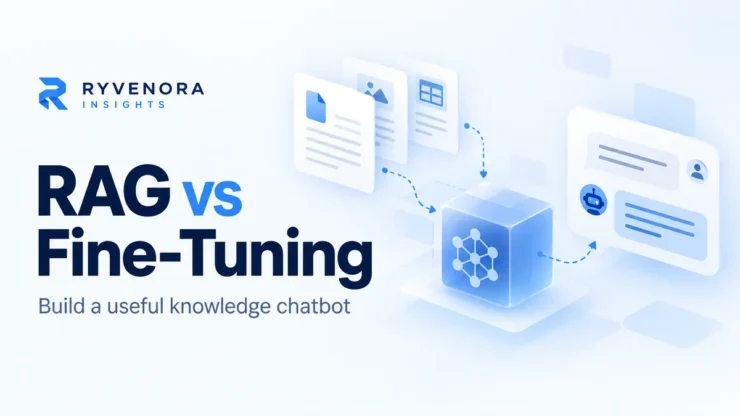
A typical RAG service finds relevant passages in a searchable collection, adds them to the model’s input alongside the question, and generates an answer using that context. Search may use keywords, semantic matching, vectors, or a combination. Microsoft’s RAG overview describes this retrieve, augment, and generate workflow.
For example, imagine an employee asks which approval is required before ordering equipment. The service retrieves the relevant purchasing section and sends that section with the question. The response should explain the approval step and point to the supporting section. This is a hypothetical workflow, not a tested result.
That creates two separate opportunities for failure. Search can select the wrong policy, or generation can misread the right policy. Seeing a plausible final answer does not reveal which component worked. Keep enough diagnostic information to inspect the retrieved passages and the answer together, subject to your organization’s logging and retention rules.
When fine-tuning fits a knowledge chatbot
Fine-tuning is worth investigating when examples can teach a stable pattern that ordinary prompting has not delivered reliably. Possible candidates include a recurring response format, specialized language, or a narrow classification task. AWS’s proof-of-concept architecture guidance recommends starting with prompt engineering and considering more involved approaches when that baseline is insufficient.
For a workplace assistant, a hypothetical training example might teach how to turn a supported answer into a standard “decision, reason, next step” response. Another might teach a routing label for a request. Neither example makes the model the authoritative store of your latest procedures.
Before training, collect representative examples and reserve a separate evaluation set. Include difficult inputs, not just polished demonstrations. Remove unnecessary personal or confidential information, and verify that the provider’s training and retention arrangements fit your requirements. Do not put facts that must be withdrawn promptly into training merely because uploading a file looks convenient.
Consider the combination only after diagnosing both needs. A tuned response pattern can sit above a retrieval system, but it still needs current, authorized evidence for document-specific answers. Compare the combined approach with your simpler baseline so you can see whether the extra maintenance produces a useful improvement.
Prepare the knowledge before changing the model
A practical preparation checklist is:
- Name an owner: someone must decide which version is authoritative and when it expires.
- Keep useful structure: retain headings, table labels, exceptions, and document titles when extracting text.
- Record provenance: store a source link, section identifier, version or effective date, and access information with each indexed unit.
- Review conflicts: decide how the assistant should handle two documents that disagree.
- Check extraction: inspect representative files before assuming their searchable text matches what a person reads.
Split documents around meaningful sections. An isolated sentence may lose an exception in the next paragraph; a very large passage may bury the relevant instruction. There is no universal chunk size that resolves both problems. Experiment with your actual questions and inspect what each configuration retrieves.
Write an answer contract before implementation. For example: answer only when permitted sources support the decision, identify the relevant section, and say when the evidence is insufficient. Also decide whether the assistant may summarize disagreements or must send the reader to a named owner. These are product choices you can evaluate, not assumptions to leave inside an unwritten prompt.
Enforce access before text reaches the model
A login identifies a user; your retrieval layer must also determine which documents that user may use. Microsoft’s document-level access guidance describes approaches for carrying permissions through indexing and query execution. The appropriate implementation depends on the source system and identity setup.
For your application, require authorization before retrieved content enters the model’s context. Hiding a citation or suppressing a final answer does not undo an earlier exposure. Test with users from different groups, including someone who can open one document but cannot open a closely related restricted file.
Make document changes part of the same design. Set a freshness target, monitor failed imports, and test a replacement, a deletion, and an access revocation. Verify that outdated copies stop influencing answers through retrieval, caches, and any stored conversation context. A source link returning an error is insufficient evidence that its old text has disappeared everywhere.
Documents can contain instructions that try to redirect the assistant. Microsoft’s RAG guidance flags this prompt-injection risk. Treat retrieved content as evidence to examine, and keep application instructions and authorization decisions outside its control.
Evaluate retrieval, answers, and refusal separately
Build a fixed set of realistic questions with expected supporting passages or reference answers. Include paraphrases, ambiguous wording, and questions whose answer is absent. Google’s RAG retrieval evaluation guidance recommends using consistent evaluation data to compare changes and separating retrieval problems from generation problems.
For each failure, first inspect the passages returned. If the decisive section is missing, changing the answer prompt is unlikely to repair the root problem. If the section is present, review whether the generated answer respects its conditions and exceptions. Change one component at a time when possible.
| Hypothetical test | Expected behavior | Failure to investigate |
|---|---|---|
| Ask about a revised purchasing rule | Use the effective version and cite it. | Stale ingestion or ranking |
| Ask a restricted question as an ordinary user | Reveal no restricted information. | Authorization or caching |
| Ask for an undocumented exception | State the gap and give an appropriate next step. | Unsupported invention |
| Ask about a rule with a nearby exception | Include the qualifying condition. | Incomplete context or interpretation |
| Insert a conflicting instruction into a test document | Keep application rules in force. | Prompt-injection handling |
Track distinct measures instead of one “accuracy” label. AWS’s knowledge-base evaluation metrics distinguish retrieval relevance and coverage from answer correctness, completeness, faithfulness, and citation precision. In practical terms, ask whether the system found useful evidence, answered the question, stayed within that evidence, and attached sources that support its claims.
A grounded answer can still rely on an outdated or incorrect document. A valid link can also support only part of a sentence. Review the underlying evidence; Ryvenora’s guide to verifying AI-generated citations provides a useful reader-side checking process.
Automated scoring helps compare experiments, but use human review for consequential examples. AWS explains its LLM-based evaluation results as scores for particular dimensions. Treat scores as diagnostic signals, not a guarantee that every response is suitable for use. Record serious failures individually even when an average looks encouraging.
Plan a useful pilot and its costs
Start with one bounded collection, a named audience, and a clear owner. A hypothetical first pilot could cover equipment purchasing procedures for one department. Define acceptable support for answers, handling of missing evidence, and response time before inviting users. Keep a direct route to the original documents and a way to report incorrect answers.
Budget across the whole service. RAG can add document processing, embeddings, search storage and queries, and longer model inputs; Microsoft’s architecture overview describes these extra retrieval and token costs. Fine-tuning adds dataset preparation, training, evaluation, and maintenance alongside inference. Compare the current pricing of the actual services you intend to use rather than assuming either approach is always cheaper.
Measure cost per useful completed question during the pilot, including retries and human follow-up. Record typical and slower response times, failed imports, and reviewer effort. Expand only when the service answers the defined questions reliably enough for its purpose and someone can maintain the document and permission pipeline.
Common questions about RAG and fine-tuning
Does RAG eliminate hallucinations?
No. Retrieval can miss evidence, and generation can add unsupported claims or misinterpret a passage. Evaluate source support and provide a useful fallback when the evidence is insufficient.
Can fine-tuning teach facts?
Training can influence factual responses, but that does not provide a dependable update, deletion, authorization, or source-link workflow. For frequently revised internal documents, evaluate retrieval as the knowledge layer.
Do we need a vector database immediately?
No. RAG describes a workflow, not a mandatory database product. Start with a search approach suited to your collection and compare it against representative questions before choosing infrastructure.
Should we use RAG and fine-tuning together from the start?
Usually establish a simpler baseline first. Add training when a persistent, measurable behavior problem remains, and check that it improves held-out questions without weakening source support or access handling.


Add comment